10 big box PC games from the golden era
A photo essay of 10 big box PC games from the 1980s and early 90s, from Zak McKracken to SimCity and Sid Meier's Pirates! You're welcome.

Picture the scene. A cardboard moving box, opened on a parquet floor. Inside, around two dozen vintage PC games in their original big boxes, spanning roughly 1982 to 1993. Such precious treasure!
The collection doesn't belong to me. But I was granted access for an afternoon, long enough to photograph the contents in a bad light with a shaky hand, and long enough to be reminded that for about a decade, a computer game was a physical object designed with real care.
The cover art on the box was the advertisement, the manual was the tutorial, and the contents often included maps, props and printed ephemera that no download has ever replicated. A few of these games also hold handwritten notes, puzzle solutions meticulously worked out in pencil and folded in with the disks.
Here's a selection of 10 of those games, together with some notes about their importance (I think) to the history of the medium.
1. Zak McKracken and the Alien Mindbenders (1988)
The IBM PC box has marbled endpaper borders, like a Victorian ledger, and cover art that walks a fine line between the ridiculous and the sublime. Inside are diskettes in both 5.25 and 3.5 inch formats, and your PC requires a trifling 256K RAM to run it.
Zak was the second game built on SCUMM (opens in a new window) (Script Creation Utility for Maniac Mansion), the Lucasfilm Games engine that replaced typed commands with clickable verbs, and in terms of release it sits chronologically between Maniac Mansion and the Monkey Island series that made the studio famous.
The satire and general silliness were very on-brand for the studio. Zak writes invented stories for a supermarket tabloid, and the box includes a mock issue of the National Inquisitor as a prop. The anti-piracy codes can be found in a booklet that doubles as an exit visa.
The game found its biggest audience in Germany, apparently, where it became a generational touchstone and still elicits gushing tributes from the local games press (opens in a new window).
2. Microsoft Flight Simulator 2.0 (1984)
The oldest box in the collection, with a diagonal banner announcing that the program is "now taking off in color on RGB monitors". Colour was the headline feature and biggest improvement, evidently.
Microsoft licensed the simulator from Bruce Artwick's subLOGIC in 1982, and throughout the eighties it doubled as a hardware test. IBM-compatible clones were judged by whether they could run Lotus 1-2-3 and Flight Simulator, two programs that poked the hardware thoroughly enough to expose any shortcut a clone maker might have taken.
It's also the intellectual property with the greatest longevity in this list by a wide margin. The franchise shipped its most recent instalment in 2024, which makes it older than the Windows operating system and still going strong.
3. Ultima V: Warriors of Destiny (1988)
Richard Garriott's Ultima series established the template for computer role-playing games as we know them, a genre where you guide a character through an open world and grow their abilities over dozens of hours.
This edition of Ultima V is a black box for IBM and compatibles, three hooded Shadowlords on the cover and, inside, the standard Origin Systems kit of "feelies", or physical items. A cloth map of Britannia, a metal coin, and a lore book written in character.
The fifth entry did something unusual with its own mythology. The previous game had you embody eight virtues. This one shows those virtues codified into law by a tyrant and enforced with cruelty, and asks you to live with the consequences. Games rarely interrogated their own moral systems in 1988. Most still don't.
4. Space Quest, Chapter I: The Sarien Encounter (1986)
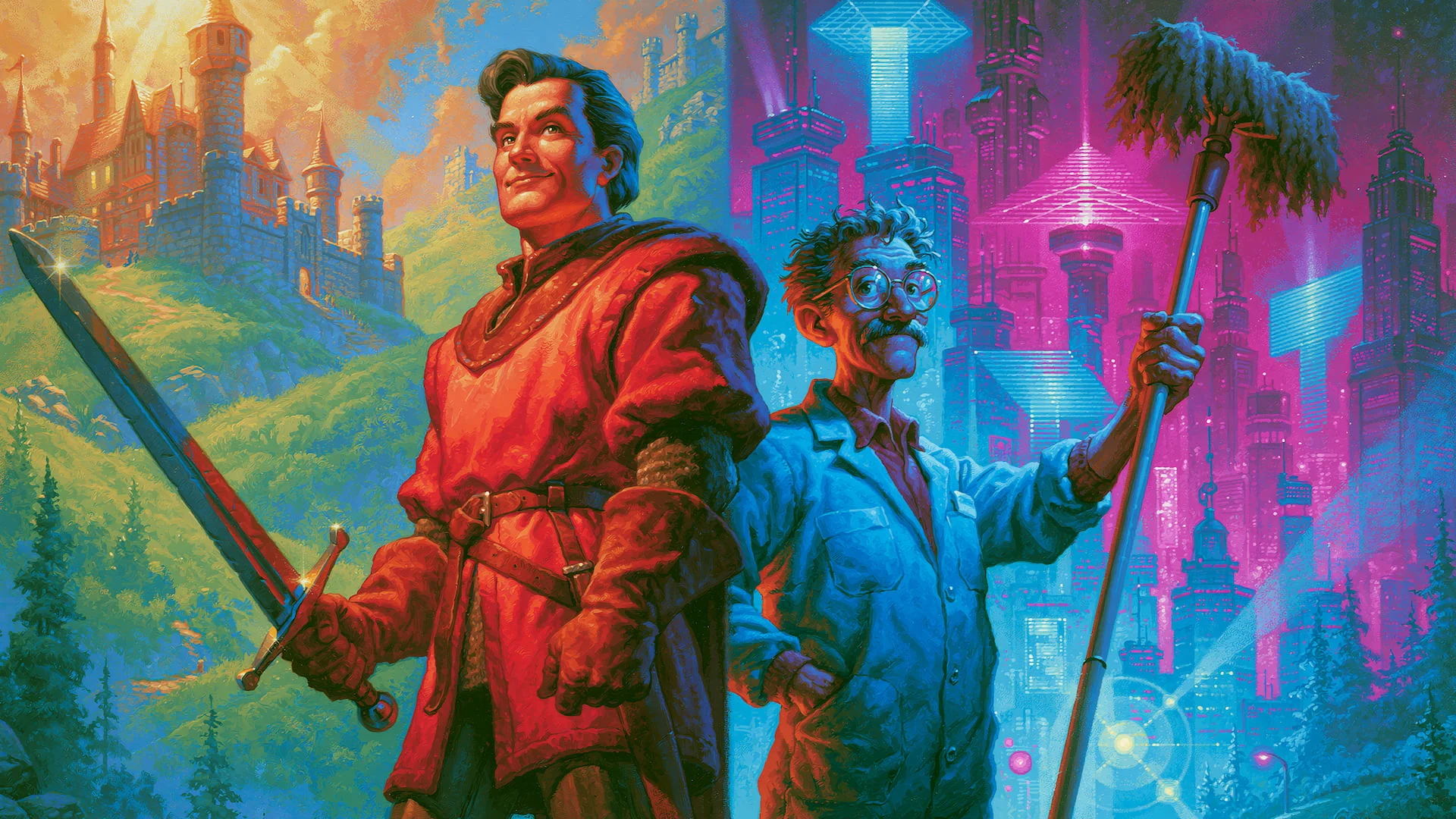
The logo is rendered as chunky sci-fi masonry floating in space, and the hero of the game is but a lowly janitor. Roger Wilco sleeps through an attack on his research vessel and stumbles into a quest to save the galaxy.
At a time when adventure game protagonists were chisel-jawed knights and detectives, Sierra let two designers who billed themselves as the Two Guys from Andromeda build an MS-DOS comedy where the lead is defined by the quality of his mop.
The series became infamous for killing the player in creative ways that made every death a punchline, complete with a sarcastic narrator who seemed to relish the spectacle. The formula carried Roger Wilco through five sequels, and he remained a janitor at heart through all of them.
5. Police Quest: In Pursuit of the Death Angel (1987)
Another game, another quest, this one with bullet holes punched through the title (which oversells the action considerably).
Police Quest was written by Jim Walls, a California Highway Patrol officer with fifteen years of service, and it plays like a procedure manual.
You read suspects their rights, you follow radio codes, you walk around your patrol car to inspect it before driving, and the game fails you for skipping any of it. As entertainment, this was a strange proposition.
But as design, it was one of the most committed realism experiments of the decade, and every by-the-book police simulation since, from SWAT to Police Simulator, is descended from it.
6. Sid Meier's Pirates! (1987)
The box art is painted as a tattered piece of parchment, and above the title sits a name. This was the first game to carry "Sid Meier's" in its title, a branding decision MicroProse made because his flight simulations already sold well based on his reputation.
Pirates! first appeared on the Commodore 64, and this IBM PC version followed shortly after. It dropped you into the seventeenth-century Caribbean with a ship and no fixed goal. You could raid, trade, duel, court a governor's daughter or hunt for lost family, and the game simply kept up.
That open structure, a historical world that responds to whatever you choose to do in it, leads directly to Civilization four years later, and contributed to a large share of modern game design thereafter.
7. Leisure Suit Larry Goes Looking for Love (In Several Wrong Places) (1988)
A pelican perches on a sign reading "Nude Beach" while the hero surfs and gurns in wraparound sunglasses. Al Lowe's Larry Laffer, a balding lounge lizard in a white polyester suit, was mainstream MS-DOS software in a way that seems improbable today.
The boxes sat on ordinary shop shelves, the series sold in the millions, and the games guarded their adult content with trivia questions only an adult of 1988 could plausibly answer, covering tax forms, seventies television and American politics.
Kids traded the answers in playgrounds anyway, which everyone involved seems to have understood. The quiz became better remembered than most of the jokes it protected.
8. SimCity (1989)
The cover is an aerial photograph of a city annotated with a marker pen. Airport, stadium, industrial zone, harbour. The city, oddly enough, is Sydney, Australia (you can tell by the Opera House), in a game about generic American urban planning.
Will Wright built SimCity out of a map editor he had made for an earlier game, after noticing he enjoyed the editor more than the game. Publishers turned it down because it couldn't be beaten in the traditional sense. There's no ending, no victory screen, only a city that responds to your zoning decisions and tax rates.
The IBM PC version photographed here sold alongside ports to nearly every other platform (including the Nintendo Entertainment System), invented the simulation genre as a commercial category, and gave a generation their first intuition of how a mixed-use district was supposed to work.
9. Populous (1989)
Two massive hands cup a glowing planet, one holding it in place, one throwing lightning against it. And thus Populous introduces itself to the world. Journalists needed a term for a game where you play a deity influencing a world of tiny worshippers rather than any single character, and the best they could do was "god game".
This was the first release from Bullfrog, and Peter Molyneux's debut, and the IBM version shipped with a two-player mode that worked over a serial cable or modem, years before online play existed as a consumer idea. Electronic Arts expected modest numbers in terms of sales but actually sold millions.
10. King's Quest VI: Heir Today, Gone Tomorrow (1992)
The box carries a gold seal claiming the best-selling computer game series of all time, over 1.5 million King's Quest sold, and for once the marketing was close to the truth.
Roberta Williams had all but invented the graphic adventure with the first King's Quest in 1984, a game that put an animated character on screen and let you walk him around at a time when adventure games were still text and static pictures.
The sixth is where the series peaked. Prince Alexander is shipwrecked on the Land of the Green Isles searching for a princess he glimpsed in a magic mirror, and the game branches into two routes and five possible endings, an unusual amount of freedom for 1992.
The box included a printed Guidebook to the Land of the Green Isles, an in-world travelogue you needed to solve several of the puzzles, so the story spilled out of the disks and into a physical booklet in your hand. Williams co-designed the game with Jane Jensen, who went on to create the Gabriel Knight mysteries.
The disks and the boxes
Every one of these big boxes is a relic of a bygone age. But the taglines still sell, the painted covers still stop your eye, and the spec stickers navigate different hardware standards.
They also document one of the earliest format "wars" to impact PC gaming. Flight Simulator, SimCity, and Pirates! originally shipped on 5.25 inch floppies, the big bendable ones. By 1988 publishers could no longer assume which drive a buyer owned, so Zak, Space Quest, Police Quest and Larry all shipped with both formats in one box, the same game on 5.25 and 3.5 inch disks riding together.
The disks themselves are another matter. Archivists generally estimate 10 to 20 years of reliable life for floppy media, and every disk in these boxes is decades past that. Some will still read, maybe, but even then the drives that could accept them are museum pieces in themselves.
The games, though. These still survive through emulation, remakes and remasters, not to mention amateur efforts at digital preservation. These big boxes that originally housed them, they're still safely stored in a cardboard carton, for future generations to marvel at and appreciate.